
If you’re planning a multi‑country trip through Europe—whether it’s soaking up the culture in Rome, working remotely from Berlin, or hiking in the Swiss Alps—staying connected seamlessly across borders is essential. A 5G eSIM offers the convenience of a digital SIM combined with the fastest available network speeds. But with Europe’s diverse mobile landscape, varying 5G rollout, and the EU’s “roam like at home” rules, is a 5G eSIM the right choice for your European adventure? This guide explains everything you need to know about using a 5G eSIM in Europe, including coverage, providers, and how to choose the best plan.
Europe has a patchwork of mobile networks, but the good news is that the EU’s roaming rules mean you can use a SIM or eSIM from one EU country across the entire EU without extra roaming charges. This applies to 5G as well—if your eSIM plan includes 5G in the home country, you’ll generally get 5G in other EU countries where the local carrier has 5G coverage. However, the quality of 5G varies significantly by country and even within countries.
When choosing a 5G eSIM for Europe, you have two main options: global eSIM providers offering European regional plans, and local European carrier eSIMs that offer EU‑wide roaming.
**Global eSIM providers** like Airalo, Nomad, Holafly, and Ubigi offer Europe‑wide eSIM plans. These are convenient—you buy one plan that works across multiple countries. Many of these plans now include 5G access where available. For example:
**Airalo** offers “Eurolink” plans that cover 39 European countries. Their plans typically use a combination of local carriers, often including 5G in major cities. Data allowances range from 1GB to 20GB.
**Nomad** similarly offers Europe regional plans with fixed‑total or daily‑cap options. 5G is supported in countries where their partner networks have it.
**Holafly** specializes in unlimited data plans. Their Europe eSIM includes unlimited data with 5G in supported countries—ideal for heavy users who want to stream and work remotely without worrying about data caps.
**Ubigi** offers Europe plans that often use top‑tier local networks like Orange in France, Deutsche Telekom in Germany, and TIM in Italy. Their 5G coverage is excellent in major cities.
**Local European carrier eSIMs** are another option. If you’re flying into a specific country, you can buy a prepaid eSIM from a local carrier and use it across the EU. For example:
**Deutsche Telekom** (Germany) offers prepaid eSIMs with 5G and EU roaming. Their network is one of the best in Europe.
**Orange** (France) offers the “Orange Holiday” eSIM with 20GB of data, 5G in France, and EU roaming.
**Vodafone** (various countries) offers prepaid eSIMs with EU roaming.
**TIM** (Italy) and **Movistar** (Spain) also offer prepaid eSIMs with 5G and EU roaming.
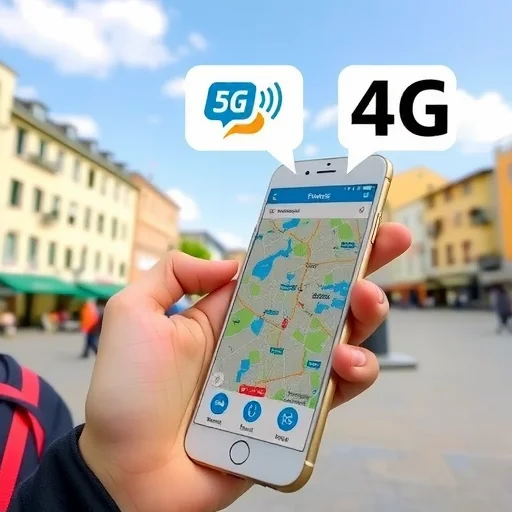
Now, let’s talk about 5G coverage in Europe. 5G rollout varies widely. Countries like Germany, France, Italy, Spain, the UK, Switzerland, and the Nordic countries (Sweden, Finland, Denmark) have extensive 5G coverage in cities and along major transport routes. In Eastern European countries like Poland, Czech Republic, and Hungary, 5G is growing but may be concentrated in larger cities. In rural areas, the Alps, and the Mediterranean islands, 5G coverage is less consistent—you’ll often fall back to 4G, which is still very reliable.
This means that while a 5G eSIM will give you fast speeds in major European cities, your overall connectivity will depend on the local network’s 4G coverage in rural areas. For most travelers, 4G is more than sufficient for maps, messaging, social media, and even streaming. The real benefit of 5G is in crowded urban areas where 4G can become congested, and for tasks like large file downloads or high‑quality video calls.
Let’s look at a few scenarios to help you decide.
**Scenario 1: Multi‑city rail trip.** You’re traveling by train through France, Germany, Switzerland, and Italy. You’ll be in cities most of the time, with occasional countryside views from the train. You want fast data for maps, streaming, and social media. A Europe‑wide eSIM from Airalo or Holafly with 5G will give you great speeds in cities. Since you’re on the move, the convenience of a single eSIM that works across borders is ideal. Choose a 10GB plan if you’re a moderate user, or unlimited if you’re streaming heavily.
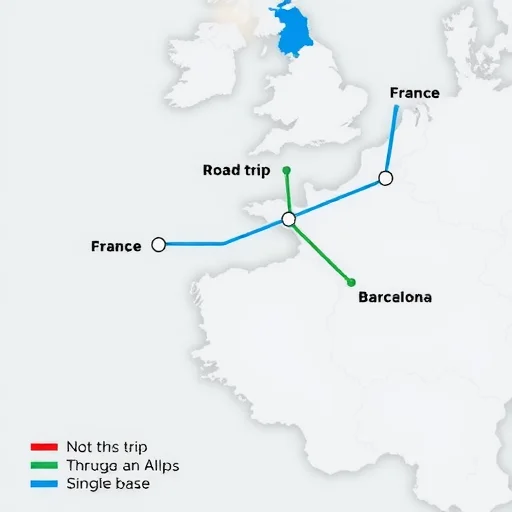
**Scenario 2: Road trip through the Alps.** You’re driving through Austria, Switzerland, and northern Italy. You’ll be in mountainous areas with variable coverage. 5G will be available in towns but may drop to 4G in valleys and passes. A local carrier eSIM from a country with strong alpine coverage, like Swisscom in Switzerland or Deutsche Telekom in Germany, might give you the best overall network quality. However, a regional eSIM will also work fine—just don’t expect 5G in remote areas.
**Scenario 3: Working remotely from a single base.** You’re staying in Barcelona for a month, working remotely. You need reliable, fast data for video calls and file transfers. A local Spanish carrier eSIM (e.g., Movistar or Orange Spain) with 5G and a large data allowance might be the best value. Alternatively, a Holafly unlimited plan gives you the convenience of not worrying about data caps, and you’ll have 5G in the city.
Now, let’s talk about device compatibility. To use a 5G eSIM in Europe, your phone must support both eSIM and the 5G bands used in Europe. Most modern iPhones (12 and newer), Google Pixels (5 and newer), and Samsung Galaxy flagships (S20 and newer) support European 5G bands. However, if you have a phone from a different region (e.g., a US model), it’s worth checking that it supports European 5G frequencies (n1, n3, n7, n8, n20, n28, n78 are common). Most recent international phones are fine, but older or region‑specific models may have limited band support.
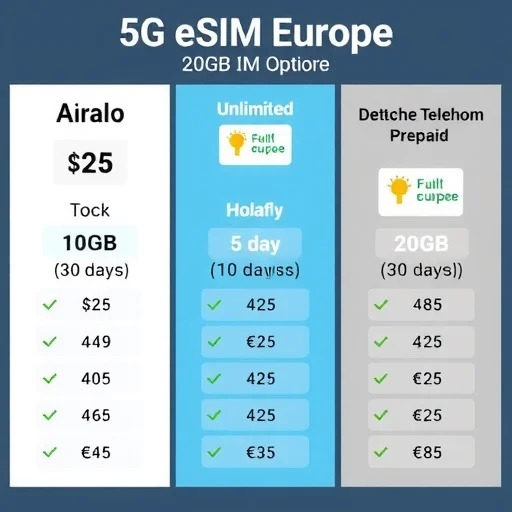
Cost is another factor. Europe‑wide eSIMs from global providers are priced competitively. For example, a 10GB Airalo Eurolink plan costs around $25 USD for 30 days. A local carrier prepaid eSIM might give you 20GB for €20–€25. For longer stays (2 weeks or more), local carrier eSIMs often offer better value per GB. For short, multi‑country trips, the convenience of a regional eSIM is hard to beat.
I recently helped a friend plan a three‑week trip through France, Belgium, the Netherlands, and Germany. She opted for a Holafly unlimited Europe eSIM with 5G. She installed it before departure, and it worked seamlessly across all four countries. In Paris, Amsterdam, and Berlin, she had 5G with fast speeds. On trains between cities, she had reliable 4G. The unlimited plan meant she never worried about data—she streamed music, made video calls, and even tethered her laptop. She said the convenience of a single plan for the whole trip made it stress‑free.
Another friend, who was spending a month in Italy for work, bought a local TIM prepaid eSIM. He got 50GB of data, 5G in cities, and a local Italian number for about €25. He used it for video calls, file uploads, and navigating around Rome and Florence. He appreciated having a local number for restaurant reservations and delivery apps.
If you’re traveling to non‑EU countries like Switzerland, the UK, or Norway, check whether your Europe eSIM includes them. Some “Europe” plans include Switzerland and the UK; others do not. Holafly, for example, includes Switzerland and the UK in their Europe plan. Always read the coverage list carefully.
In summary, a 5G eSIM is a great choice for European travel if you have a compatible phone and will be spending time in cities where 5G is available. For multi‑country trips, a Europe‑wide eSIM from a global provider offers unmatched convenience. For longer stays in a single country, a local carrier eSIM may offer better value and a local number. And for travelers who prioritize coverage over speed, remember that 4G across Europe is still excellent—so a 5G plan is a nice bonus, not a necessity. For European travel, a 5G eSIM offers fast speeds in major cities and seamless EU roaming without extra charges. Choose a Europe‑wide eSIM from providers like Airalo, Nomad, or Holafly for multi‑country convenience; opt for a local carrier eSIM (Deutsche Telekom, Orange, TIM) for longer stays or if you need a local number. 5G coverage is strongest in Western European cities; 4G remains reliable in rural areas.
EuropeTravelConnectivityFINISHED
I bought a Deutsche Telekom prepaid eSIM for a month in Germany and used it in Austria and Czech Republic too. 5G in cities was fast, and EU roaming worked perfectly. Having a German number was handy for local bookings.
For a month‑long stay in Italy, I got a local TIM eSIM with 50GB of data. 5G in Rome and Milan was blazing fast. The local number was useful for calling restaurants. Better value than a regional eSIM for long stays.
I’m a light user—maps, messaging, social media. A 5GB Airalo Eurolink plan was plenty for 10 days across Spain and Portugal. Had 5G in Barcelona and Lisbon, 4G everywhere else. Perfect for my needs.
Used a Holafly unlimited Europe eSIM for a 2‑week trip across France, Switzerland, and Italy. Had 5G in all the major cities and good 4G everywhere else. Unlimited data was great for streaming and video calls. Highly recommend.
Important tip: Not all “Europe” eSIMs include Switzerland or the UK! I had to buy a separate plan for Switzerland. Check the coverage list carefully before buying.